Community College News

Stay abreast of all the news and reports impacting community colleges. This section covers the latest news stories, from campus protests to Wal-Mart partnerships. Read community college reactions to the latest State of the Union address, identify schools receiving big donations, and analyze the latest laws impacting community colleges and their students.

View the most popular articles in Community College News:

First-Generation Student Guide to Community College Success

Updated
|
First-Generation Student Guide to Community College Success
A first-generation student guide to navigating your first semester at community college, with academic, financial, and campus life strategies.

First-Generation Student Guide: Navigating Your First Semester at Community College

Starting college is a major milestone. For first-generation students, it can feel especially complex. This first-generation student guide is designed to help students and families understand what to expect during the first semester at community college, how to prepare effectively, and how to use available support systems with confidence.

A first-generation student guide matters because students whose parents did not complete a four-year degree often enter college without informal knowledge about higher education systems. Community colleges serve nearly half of all first-generation undergraduates in the United States, according to recent enrollment trends, making this first-generation student guide particularly relevant in 2026.

This first-generation student guide focuses on practical steps, academic habits, financial planning, and campus engagement strategies that support a strong start.

Understanding What It Means to Be a First-Generation College Student

A first-generation college student is typically defined as a student whose parents or guardians did not earn a bachelor’s degree. This first-generation student guide emphasizes that this status is not a disadvantage. Instead, it reflects resilience, motivation, and the ability to navigate new systems successfully.

Community colleges are uniquely positioned to support first-generation students. Smaller class sizes, flexible schedules, and wraparound services make them an ideal starting point. This first-generation student guide highlights how to take advantage of those features from the first week of classes.

Preparing Before the Semester Begins

Early preparation sets the tone

. . .read more

Most In-Demand Community College Majors for 2025–26

Updated
|
Most In-Demand Community College Majors for 2025–26
Explore the most in-demand community college majors for 2025–26 workforce needs, aligned with hiring trends, wages, and transfer pathways.

Most In-Demand Community College Majors for 2025–26 Workforce Needs

Community colleges sit at the center of America’s workforce pipeline. As industries adapt to automation, healthcare demand, climate priorities, and digital transformation, the most in-demand community college majors are shifting in clear and measurable ways. For the 2025–26 academic year, students and families are increasingly focused on programs that offer strong job placement, stackable credentials, and pathways to bachelor’s degrees.

This guide examines the most in-demand community college majors for 2025–26 workforce needs, drawing on labor projections, employer hiring trends, and enrollment data. It is designed to help students, parents, and educators understand where opportunity is strongest and how community colleges are responding.

Why In-Demand Community College Majors Matter More Than Ever

Rising tuition costs and uncertain labor markets have made return on investment a central concern. The most in-demand community college majors provide a practical solution. These programs typically combine lower tuition, shorter completion timelines, and strong alignment with regional workforce needs.

According to the U.S. Bureau of Labor Statistics, many of the fastest-growing occupations over the next decade require postsecondary credentials but not a four-year degree, making community college pathways especially relevant for 2025–26 workforce needs. Community colleges are also expanding employer partnerships and work-based learning, further strengthening the value of these majors.

Key Criteria Used to Identify the Most In-Demand Community College Majors

To determine the most in-demand community college majors for 2025–26 workforce needs, several factors

. . .read more

Work-Study Opportunities for Spring 2026 Guide

Updated
|
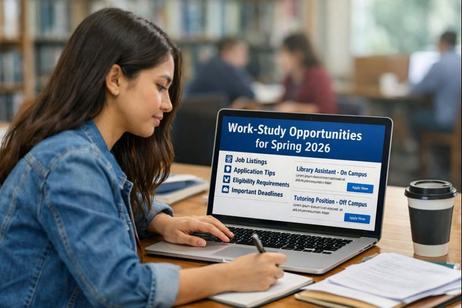
Work-Study Opportunities for Spring 2026 Guide
Learn how to secure work-study opportunities for Spring 2026 before classes start, including timelines, tips, and eligibility guidance.

Work-Study Opportunities for Spring 2026: How to Find a Job Before Classes Start

For many college students and families, work-study opportunities for Spring 2026 will play a critical role in making higher education affordable. While work-study programs are often associated with the fall semester, an increasing number of students rely on work-study opportunities for Spring 2026 to cover living expenses, reduce student loan borrowing, and gain meaningful work experience.

Planning ahead is essential. Students who wait until classes begin often find that the best work-study opportunities for Spring 2026 are already filled. By understanding how the program works and taking early action, students can position themselves for success well before the spring term starts.

This guide explains what families should know about work-study opportunities for Spring 2026, where to find them, and how to secure a position before classes begin.

Understanding Work-Study Opportunities for Spring 2026

The Federal Work-Study Program is a need-based financial aid program administered by colleges and universities. It allows eligible students to earn money through part-time employment while enrolled in school. Work-study opportunities for Spring 2026 typically include both on-campus and approved off-campus positions, often related to community service or a student’s academic interests.

While funding is awarded annually through the Free Application for Federal Student Aid, many institutions allocate remaining funds to spring-only students or to those whose circumstances have changed. As a result, work-study opportunities for Spring 2026 remain available, but competition can be strong.

. . .read more

Nontraditional Student’s Guide to Community College 2025

Updated
|
Nontraditional Student’s Guide to Community College 2025
Comprehensive guide for nontraditional students at community college with updated tuition, support, careers, and success strategies for 2025.

A Nontraditional Student’s Guide to Community College

Community college remains a vital pathway for millions of learners across the United States, especially for nontraditional students managing work, family, finances, and other life responsibilities while pursuing education. This guide updates key 2025 data, trends, and practical insights for parents, students, educators, and policymakers considering community college options.

What Is a Nontraditional Student?

A nontraditional student is typically defined as someone who does not follow the traditional college trajectory of enrolling full time soon after high school graduation. Common characteristics include:

  • Being age 25 or older when first enrolling

  • Working part time or full time while attending college

  • Having children or other dependents

  • Delaying entry into higher education or returning after a gap

  • Enrolling part time rather than full time

Nontraditional learners often juggle competing responsibilities and require flexible academic and financial support to succeed.

Community College Enrollment Today

Community colleges educate a significant share of U.S. undergraduates. As of 2025, these institutions enroll roughly 10.5 million students across credit and noncredit programs, reflecting a rebound from previous declines and continued strength relative to four-year institutions. Head-count enrollment grew by about 3.9 percent from fall 2023 to fall 2024, driven by both younger and adult learners.

More broadly, community colleges account

. . .read more

Community College Success Rates 2025: Outcomes & Trends

Updated
|
Community College Success Rates 2025: Outcomes & Trends
Updated 2025 analysis of community college success rates, completion, transfer, costs, enrollment, and strategies that shape student outcomes.

Success Rates: How Community Colleges Measure Up (2025)

Community colleges remain a vital gateway to higher education and workforce preparation in the United States, serving millions of learners with diverse goals and backgrounds. As we reach 2025, the conversation around community college success has evolved, shaped by changing enrollment patterns, shifting federal and state policies, and renewed focus on completion and workforce alignment. In this updated report, we examine the most recent data on success rates across community colleges, what they mean for students and families, and how institutions are responding to challenges and opportunities in 2025.

What Do We Mean by “Success Rates”?

In higher education, success rates encompass a range of outcomes, including graduation, transfer to four-year institutions, persistence from term to term, and attainment of workforce credentials. Traditional metrics like graduation within three or six years provide important benchmarks, but contemporary analyses also consider short-term credentials, transfer outcomes, and employment post-completion.

Most community college students enroll part-time, work while studying, or balance family and life obligations. As a result, success metrics that rely solely on time-to-degree can understate real achievement. Broader success measures include persistence, credential attainment, and career relevance.

Enrollment Trends and the Student Body in 2025

After years of enrollment declines following the COVID-19 pandemic, community colleges have seen a meaningful rebound. Across the sector, public two-year colleges reported enrollment increases of approximately 4.0% in most recent data, outpacing four-year institutions in year-over-year

. . .read more

Recent Articles

Test Article, Image and Content
Test Test Test Test Test Test Test Test Test Test Test Test Test Test Test Test Test Test Test Test Test Test Test Test Test Test Test Test Test Test Test Test Test Test Test Test Test Test Test Test Test Test Test Test Test Test Test Test Test Test Test Test Test Test Test Test Test Test Test Test Test Test Test Test Test Test Test Test Test Test Test Test Test Test Test Test Test Test Test Test Test Test Test Test Test Test Test Test Test Test Test Test Test Test Test Test Test Test Test Test Test Test Test Test Test Test Test Test Test Test Test Test Test Test Test Test Test Test Test Test Test Test Test Test Test Test Test Test Test Test Test Test Test Test Test Test Test Test Test Test Test Test Test Test Test Test Test Test Test Test Test Test Test Test Test Test Test Test Test Test Test Test Test Test Test Test Test Test Test Test Test Test Test Test Test Test Test Test Test Test Test Test Test Test
Faith Formation Integrated Across Subject Areas
Explore faith formation integrated across subject areas and its impact on curriculum, student outcomes, and community colleges.
Parish-Based Governance Models in Catholic Schools
Explore parish-based governance models in Catholic schools and their impact on leadership, funding, and community colleges.