Courses in College

Be inspired by the gamut of community college courses, from the arts to technical training. This section will cover everything from remedial classes to continuing education. Community colleges offer courses for youth and teens, individuals looking for a new hobby or skill, or those behind bars looking for a second chance.

View the most popular articles in Courses in College:

Alternative Automobiles: New Training Programs at Community College

Updated
|
Alternative Automobiles: New Training Programs at Community College
Learn about the demand for technicians of alternative fuel automobiles and its future career potential. Start your career as an alternative fuel vehicle technician at your local community college.

The past decade has seen an explosion of hybrid cars powered by alternative fuels, rather than traditional gasoline. What once seemed a science fiction dream – powering cars with energy other than petroleum – is quickly becoming a reality. However, alternative fuels don’t stop with hybrid engines; experts are working on creating vehicles that can be powered by compressed natural gas, biodiesel, ethanol, and propane.

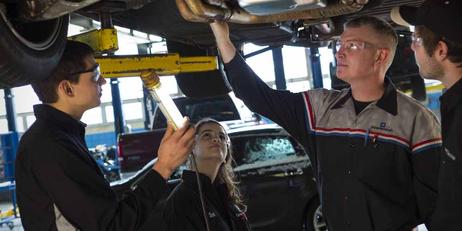
As the landscape of the American auto industry shifts to include more alternative fuel vehicles, there is an emerging market for auto technicians who are trained to service and repair these next-generation cars. For those looking for a career in the auto industry with definite growth potential, a new training program for alternative fuel technicians available at community colleges could be an excellent investment.

This video offers a brief overview of the alternative fuels training at the Santa Fe Community Colleges.

Alternative Fuels Training Centers

West Virginia University started the National Alternative Fuels Training Consortium (NAFTC) in 1992 to address the lack of technicians who were trained to work with the then-new Alternative Fuel Vehicles. In 1995, the NAFTC added six technical training centers to the existing West Virginia University center. Since then, the program has grown to include 42 members: 41 national training centers and 1 associate training center.

The training centers are located in community colleges and other institutes of higher education from California to Maine.


. . .read more

Mastering Math: A Guide to Passing Your Community College Math Requirements

Updated
|
Mastering Math: A Guide to Passing Your Community College Math Requirements
Learn about how to prepare for your community college's math placement exams, as well as excel in remedial math courses.

Increasing numbers of students are enrolling in two-year community college programs, yet only one-third will graduate with their degrees. Naturally, there are multifaceted reasons for the high dropout rate, but some reports cite the students’ struggle with math courses as playing a major role, as outlined by WNYC.

Most community colleges require that students take three placement tests before registering for classes. The placement tests include a basic math section, a reading comprehension section, and a writing composition section.

Approximately half of prospective community college students struggle with the math placement test and, thus, require at least one remedial math class. Even at community colleges, most degrees require successfully completing several college-level math classes, and many students struggle to make the grade. Lowering the community college dropout rate partly hinges on preparing students for math success.


This video offers a look at Portland Community College's math literacy program.

Math Placement Tests: How to Improve Your Score

Scoring well on the math placement test can save time, effort, and money in the long term. In most cases, remedial math classes don’t count towards degree requirements; thus, making the score on placement tests can save you tuition fees. The best way to prepare for the math placement test is to get the gray matter working again – especially if a lot of time has elapsed since your last math class.

Several

. . .read more

How Community Colleges are Lowering High School Dropout Rates

Updated
|
How Community Colleges are Lowering High School Dropout Rates
Today's high school dropout rates call for drastic measures, and community colleges are taking action to help keep students in high school. Learn about their innovative programs and how your local community college is keeping high school students on campus.

The reports and statistics pertaining to current high school dropout rates make for shocking reading. Over 7,200 children drop out of high school on a daily basis, creating over 1.3 million new dropouts annually, according to a Census data review by the Daily Beast. Of course, vocational training and blue-collar jobs are hypothetical alternatives for these teenagers, but with the economy in shambles, entry-level jobs are few and far between. K16 Bridge Plan

The impacts of this educational crisis are best exemplified in cities like Detroit, where only 25% of students graduate with a high school diploma. The Detroit area suffers from high unemployment rates, low income, soaring crime rates, negligible social services, and a generally poorer quality of life – which give high school dropouts few opportunities.

However, community colleges may soon be the savior of high school graduation rates. Innovative new community college programs have been implemented in places like North Carolina, Texas, and California to keep students in high school until they graduate, as well as to help find the places in higher education thereafter.

This video from the National Center for Education Statistics reports on declining high school dropout rates.

The Money Incentive: Community Colleges and Scholarship Programs

Cost is one of the major hurdles associated with higher education in disadvantaged areas. Many students assume that even if they do complete high school, they simply

. . .read more

Why Community College Students are Taking Classes at Midnight

Updated
|
Why Community College Students are Taking Classes at Midnight
To accommodate students' schedules, along with growing enrollment rates, community colleges are offering classes in the late evening. Learn more about why you may be taking midnight classes at a campus near you.

Hey there! With more and more people signing up for community college, the usual 8 a.m. to 8 p.m. class schedule isn't cutting it anymore. Some colleges are getting pretty creative with their class times to keep up with all the new students. Believe it or not, some students are even hitting the books at midnight!

Midnight is the New 8 AM

Diverse Issues in Higher Education reports that colleges across the country have experienced record enrollment rates for both new and returning students. As the economy forces many workers to retrain their skills, many community colleges nearly burst at the seams.

Coping with such pressures, Bunker Hill Community College in Boston sets a new example for college reform. Bunker Hill is the first college in the country to open its doors for midnight courses. According to reports, Bunker Hill has begun “Offering two classes on the graveyard shift to accommodate an unprecedented boost in enrollment attributed to the struggling economy as people look to augment their job skills without paying the tuition costs of more expensive schools.”

With several night courses offered at the start of the 2009 semester, Bunker Hill students can enroll in classes such as Principals of Psychology or College Writing, which both run from 11:45 p.m. to 2:30 a.m. throughout the semester.

These new midnight options were supported by many faculty leaders and students, who argued that the modern student has too many responsibilities to fit into traditional community

. . .read more

Fine Tune Your Vocals through Community College Singing Classes

Updated
|
Fine Tune Your Vocals through Community College Singing Classes
Those with the gift of song can take their singing to the next level with classes at community college. Learn about the courses offered at community college that can help prepare you for a singing career.

Is your voice an instrument? Whether you are interested in singing professionally or for pleasure, your local community college may be the perfect venue for fine-tuning your vocal skills. While many community colleges provide students with music classes, some campuses have added depth to their curriculum by offering classes that specifically focus on the art of singing. Consider adding a singing course as an elective or even declaring singing as your major, which could help you ultimately earn an associate’s degree in applied arts or sciences.

The benefits of singing in a choral ensemble

Singing in a choral ensemble or pursuing solo singing can be immensely rewarding experiences for individuals looking to develop their vocal skills and explore their passion for music. Participating in a choral ensemble offers numerous benefits, including learning from experienced instructors, developing harmonizing skills, and cultivating teamwork and collaboration. Singing in a group setting also allows individuals to improve their vocal technique, breath control, and pitch accuracy while fostering a deep sense of community and camaraderie with fellow singers. On the other hand, solo singing provides a platform for individuals to showcase their unique vocal abilities and express their individuality. It encourages personal growth, self-confidence, and artistic exploration.

This video offers a look at Shoreline Community College's Vocal Ensemble.

In today's digital age, promoting oneself as a singer through various social media platforms, such as TikTok, has become increasingly

. . .read more

Recent Articles

Test Article, Image and Content
Test Test Test Test Test Test Test Test Test Test Test Test Test Test Test Test Test Test Test Test Test Test Test Test Test Test Test Test Test Test Test Test Test Test Test Test Test Test Test Test Test Test Test Test Test Test Test Test Test Test Test Test Test Test Test Test Test Test Test Test Test Test Test Test Test Test Test Test Test Test Test Test Test Test Test Test Test Test Test Test Test Test Test Test Test Test Test Test Test Test Test Test Test Test Test Test Test Test Test Test Test Test Test Test Test Test Test Test Test Test Test Test Test Test Test Test Test Test Test Test Test Test Test Test Test Test Test Test Test Test Test Test Test Test Test Test Test Test Test Test Test Test Test Test Test Test Test Test Test Test Test Test Test Test Test Test Test Test Test Test Test Test Test Test Test Test Test Test Test Test Test Test Test Test Test Test Test Test Test Test Test Test Test Test
Faith Formation Integrated Across Subject Areas
Explore faith formation integrated across subject areas and its impact on curriculum, student outcomes, and community colleges.
Parish-Based Governance Models in Catholic Schools
Explore parish-based governance models in Catholic schools and their impact on leadership, funding, and community colleges.

Courses in College

REMEDIAL EDUCATION
60% of community college students need remedial courses. This section covers the classes and new developments to help students who need remedial coursework. Learn why the gap exists, how schools are combatting it and what you can do to avoid remedial classes. Get tips on mastering college math, learn what you can do to prevent repeating a class and hear what the experts have to say about remedial class placement.
KIDS AND TEENS
Community college is not just for adults. Learn about all the programs available to children and teens too. From aiding high school dropouts to ramped up summer school programs, community colleges work hard to encourage the pursuit of higher education to students of all ages.
ONLINE COURSES
Online classes give you the flexibility to learn off-campus, often at times most convenient for your schedule. Identify 10 degrees you can earn online, weigh the pros and cons of online education and find out how you can take online classes for free.
SUPPORT FOR BUSINESSES
Local business are taking advantage of special training programs at community colleges. From OSHA training to a collaboration with Goldman Sachs, community colleges are training employees for small and large businesses across the country.
FUN & ELECTIVE CLASSES
Community colleges offer a gamut of fun and interesting classes, and we give ideas that may strike inspiration for your elective choices. Learn homesteading skills, study paranormal investigating, or earn a scuba diving certificate all at a community college near you. This sections identifies some of the fun non-credit courses available at your local campus.
CONTINUING EDUCATION
Community colleges are filled with continuing education opportunities. Whether you are looking for a resume booster, new skills to earn a promotion or want to earn your degree while incarcerated, community college may be a good choice for you.